
Digital Transformation Is No Longer Optional: A Practical Roadmap for Nigerian Businesses
Digital technology is changing how Nigerian businesses operate and compete. Discover where technology should be applied first and how to measure real business benefits.
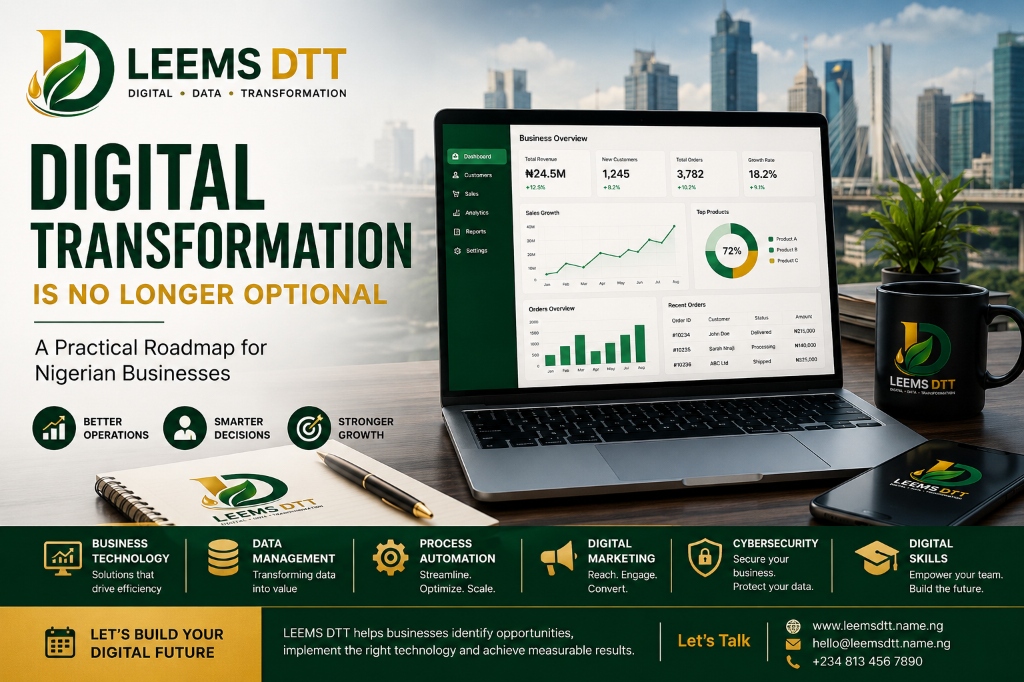
Business Need → Appropriate Technology → Measurable Benefit
Digital technology is changing how businesses operate, communicate with customers, manage information and compete in the market.
For Nigerian businesses, the issue is no longer simply whether to use technology. The more important question is where technology should be applied first, how much should be invested and how the results should be measured.
Digital transformation does not mean buying expensive software or putting your business on every social-media platform. It means using appropriate digital tools and systems to improve the way your business works.
For a small business, this might begin with digital accounting and customer records. For a growing company, it might involve automated workflows, customer relationship management, inventory systems, data analytics or integrated business software.
The objective is simple:
Business Need → Appropriate Technology → Measurable Benefit
What Is Digital Transformation?
Digital transformation is the structured use of digital technology to improve business processes, customer experiences, decision-making and organisational performance.
It involves more than converting paper records into electronic files. A business becomes more digitally capable when technology changes how work is performed and decisions are made.
For example: - A traditional business may record customer information in notebooks or scattered spreadsheets. - A digitally organised business maintains structured customer records, tracks interactions, monitors sales activity and uses the information to make decisions.
The difference is not the presence of a computer. The difference is the quality of the business system.
Why Digital Transformation Matters to Nigerian Businesses
Businesses operate in an environment where customers increasingly expect faster communication, easier access to information and more reliable service. Technology also gives businesses better ways to manage their internal operations.
A properly designed digital system can help a company: - Reduce repetitive administrative work - Improve record keeping - Track customers and sales - Monitor inventory - Improve communication - Manage projects - Analyse financial and operational information - Improve reporting - Reduce avoidable errors - Strengthen customer engagement
For growing businesses, these improvements become increasingly important. A company that depends entirely on informal processes often becomes harder to manage as its customer base, employees, transactions and projects increase.
Five Areas Nigerian Businesses Should Digitise First
Digital transformation should follow business priorities. You do not need to digitise everything at once. Start with areas where technology addresses a clear operational problem.
1. Customer Management Your customer information should not exist only in individual employees' phones. A structured customer-management system helps you record: - Customer names and contact details - Enquiries and previous interactions - Sales opportunities and orders - Follow-ups and customer preferences - Service history
This gives management a clearer picture of the customer relationship and reduces dependence on individual employees.
2. Financial Records Financial information is one of the most important forms of business data. Businesses should establish reliable systems for tracking: - Income and expenses - Receivables and payables - Cash flow and budgets - Profitability and financial commitments
The purpose is not simply to produce reports; good financial data helps management understand what is happening inside the business.
3. Sales and Marketing Digital marketing should connect to measurable business objectives. Instead of asking only “How many people saw our post?”, businesses should also ask: - How many enquiries did we receive? - Where did the enquiries come from? - How many became customers? - What was the cost of acquiring them? - Which products generated the strongest response? - Which channels produced actual business?
A website, social media account or digital advertisement becomes more valuable when it contributes to a measurable customer-acquisition process.
4. Operations and Inventory Manual operational processes often create delays and errors. Depending on the nature of the business, digital systems can support: - Inventory tracking & procurement - Project management & staff scheduling - Equipment records & supplier management - Production monitoring & document management
The appropriate system depends on the business model. A small trading business does not require the same technology architecture as a construction company or manufacturing operation.
5. Data and Reporting Businesses generate information every day: sales transactions, customer enquiries, project costs, supplier records, inventory movements and financial transactions all produce data.
The challenge is turning that data into useful information. Management should progressively move from: “What do we think is happening?” to: “What does the data show?”
This is the foundation of data-driven decision-making.
Do Not Automate a Bad Process
One of the most common mistakes businesses make is automating a process before understanding whether the process itself is effective.
Technology does not automatically fix poor management. If a business has an inefficient approval process, putting the same process into software might make it faster, but it will not necessarily make it better.
Before implementing a digital system, ask: 1. What problem are we solving? 2. How is the process currently performed? 3. Where are the delays? 4. Where do errors occur? 5. What information do we need? 6. Who needs access? 7. What should be automated? 8. How will we measure improvement?
This approach keeps technology connected to business objectives.
The Role of Digital Skills
Technology requires people who understand how to use it. A company might purchase excellent software and still obtain poor results if employees do not understand the system or do not adopt it properly.
Digital transformation therefore requires investment in people. Useful areas of training include: - Digital productivity & data management - Cybersecurity awareness & business software - Digital marketing & data analysis - Project-management & customer-management systems - Artificial intelligence tools & digital communication
The goal should be practical competence: employees should understand how technology improves their specific responsibilities.
Cybersecurity Should Start Early
As businesses become more dependent on digital systems, information security becomes increasingly important. Basic controls should include: - Strong passwords & multi-factor authentication - Access permissions & role-based controls - Regular data backups & device security - Controlled access to confidential commercial information - Software updates & employee security awareness - Incident-response procedures
The level of security should correspond with the company's digital exposure and the sensitivity of its information.
A Practical 90-Day Digital Transformation Roadmap
Digital transformation does not need to begin with a large technology budget. A phased approach is often more practical.
Days 1–30: Audit Identify how your business currently works. Document: - Major business processes - Existing software & manual processes - Repetitive tasks & information gaps - Customer-management problems & reporting weaknesses - Security risks
Then identify the three problems where technology would produce the clearest benefit.
Days 31–60: Implement Select appropriate solutions for those priority problems. Focus on: - Simplicity, cost, security - Ease of adoption & scalability - Integration & business relevance
Train the employees who will use the systems. Avoid introducing unnecessary tools.
Days 61–90: Measure After implementation, measure the results. Look at indicators such as: - Processing time & administrative cost - Number of errors & customer response time - Sales enquiries & conversion rate - Inventory accuracy & reporting speed - Employee productivity
If the system produces no meaningful improvement, review the process and technology choice. Digital transformation should be treated as an ongoing management process, not a one-time technology purchase.
Technology Should Support Business Strategy
Technology should serve the business strategy; it should not determine the strategy by itself. - A construction company might prioritise project management, cost control, procurement and site reporting. - An agricultural business might prioritise production records, inventory, market information and supply-chain management. - A professional-services firm might prioritise customer management, document management, digital marketing and financial reporting. - A trading business might prioritise inventory, supplier information, sales and logistics.
The right technology depends on the business model.
The Strategic Opportunity for Nigerian Businesses
Nigeria's business environment presents significant opportunities for organisations willing to improve their operational capabilities.
Businesses that develop strong digital systems can improve their ability to manage growth, serve customers and make informed decisions. The opportunity is especially relevant to SMEs.
Many growing businesses begin with informal systems because they are practical at the early stage. The challenge emerges when the business expands and those same informal processes become difficult to control.
Digital transformation provides a pathway from informal processes toward structured business management. The transition should be gradual: Start with the business problem → Select the technology → Train the people → Measure the result.
The LEEMS DTT Perspective
At LEEMS DTT, we believe technology should be approached from a business perspective.
The objective is not to adopt technology because it is fashionable. The objective is to identify where technology can improve efficiency, information management, customer engagement and business performance.
This principle aligns with the broader ValorTrust approach to technology, where technology serves both as a commercial capability and as an organisational enabler. The wider business strategy identifies applications across finance, procurement, human resources, customer management, project management, inventory, communication, data analysis, reporting and marketing.
The same principle applies to digital transformation: Business Need → Appropriate Technology → Measurable Benefit
Final Takeaway
Digital transformation does not require a business to become completely digital overnight. It requires disciplined improvement: 1. Understand your processes 2. Identify the problems 3. Choose appropriate technology 4. Train your people 5. Protect your information 6. Measure the results 7. Improve the system
For Nigerian businesses, the strongest digital strategy is not necessarily the one with the most technology. It is the one where technology produces clear business value.
Need Help Planning Your Digital Transformation?
Every business has different operational challenges. The right technology starts with understanding those challenges. LEEMS DTT helps businesses assess their digital needs, identify practical technology opportunities, and implement systems aligned with their operational objectives.
Stay Ahead of Palm Oil Market Prices & Sourcing Updates
Get timely notifications when bulk wholesale prices adjust, seasonal harvesting updates occur, and practical supply chain advice is published.